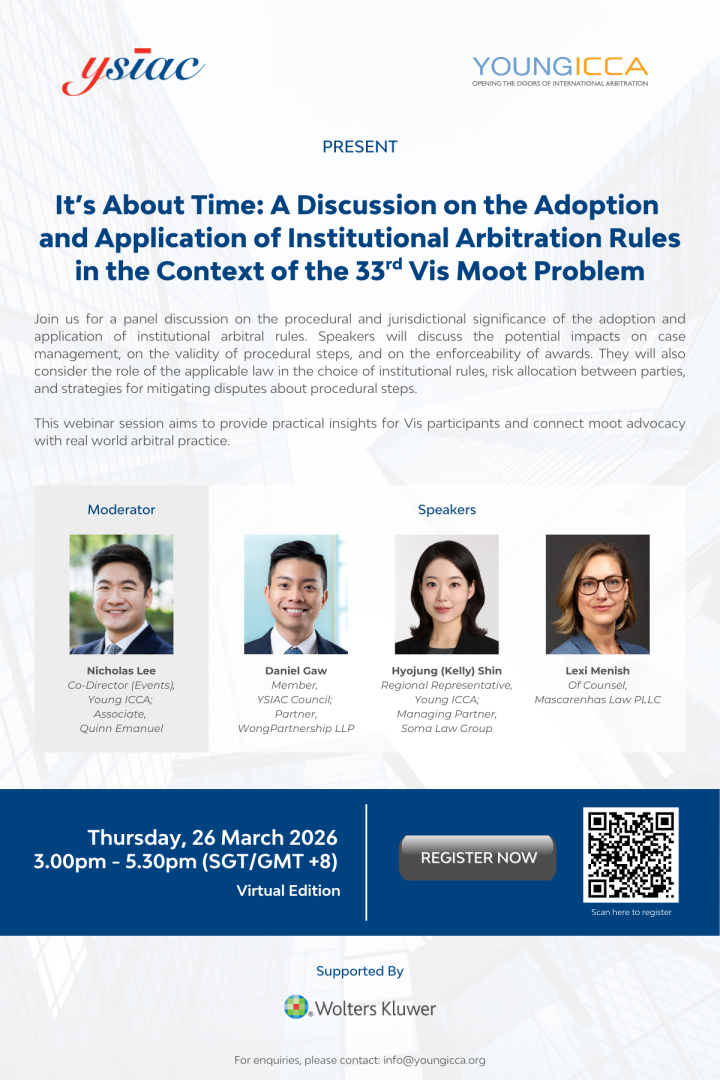
It’s About Time: A Discussion on the Adoption and Application of Institutional Arbitration Rules in the Context of the 33rd Vis Moot Problem


Join us for a panel discussion on the procedural and jurisdictional significance of the adoption and application of institutional arbitral rules. Speakers will discuss the potential impacts on case management, on the validity of procedural steps, and on the enforceability of awards. They will also consider the role of the applicable law in the choice of institutional rules, risk allocation between parties, and strategies for mitigating disputes about procedural steps.
This webinar session aims to provide practical insights for Vis participants and connect moot advocacy with real world arbitral practice.
Post-Event Report
This report is prepared by Nicholas Lee (Quinn Emanuel) and Ansar Ismagulov (ADL Disputes).
The panel discussed the procedural and jurisdictional significance of the adoption and application of institutional arbitral rules.
Moderator, Ansar Ismagulov (ADL Disputes), briefly introduced the three speakers:
Daniel Gaw is a Partner at WongPartnership in Singapore. His practice focuses on international arbitration and litigation. He is a member of the YSIAC Council and has handled SIAC proceedings and enforcement matters across multiple jurisdictions. In 2012, he achieved an Honourable Mention for Best Oralist in the Willem C. Vis International Commercial Arbitration Moot. Daniel offered an “insider’s view” on the approaches of both the SIAC and Singapore courts to the discussion.
Kelly Shin is a Managing Partner of SOMA Law Group in Seoul and a leading specialist in cross-border disputes based in Korea. She has practiced across SIAC, ICC, LCIA, HKIAC, and KCAB proceedings. Kelly was a former Co-chair of the IBA's Arb40 Subcommittee and is currently the Diversity and Inclusion Officer of the IBA Arbitration Committee. She also competed in the Willem C. Vis International Commercial Arbitration Moot. Kelly secured a sector-specific and multi-institutional perspective to the discussion.
Lexi Menish is an independent arbitrator, mediator, counsel, and founder at Menish Dispute Resolution LLC. Before that, she was a senior member of Freshfields’ international arbitration team based in New York, Tokyo, and Singapore and was formerly Of Counsel at Mascarenhas Law. She is a Fellow of the Chartered Institute of Arbitrators; sits on SIAC's Panel of Rising Arbitrators; is a professor of international commercial and investment treaty arbitration at Vanderbilt University Law School; is Chair-Elect of the International Law Section of the Oregon State Bar Association; and serves on the Steering Committee of the North American chapter of the International Federation for Investment Law and Arbitration. Lexi offered a unique, multi-faceted perspective as counsel, neutral, and academic.
1. Model vs. "Pathological" Clauses
The discussion opened with Lexi’s analysis of the varying quality of arbitration agreements. She characterized the disparity between institutional model clauses and bespoke "midnight" clauses as a fundamental risk to the "jurisdictional bedrock" of any commercial arrangement.
- Temporal Elements in Institutional Model Clauses: Lexi noted that many institutions seek to address temporal issues (that is, which version of the parties’ chosen rules applies to a given dispute) in either their rules or their model clauses. The SIAC model clause is the gold standard for clarity, utilizing the phrase "for the time being in force" to clearly signal consent to the rules active at the commencement of proceedings. Conversely, institutions like the ICC and ICDR often omit this temporal specificity in their model language, relying instead on internal preambles within their rules to fill the gap – a practice that can invite challenges regarding the parties’ actual intent at the time of contracting.
-
“Midnight” or “Pathological” Provisions: Lexi then emphasized the importance of clarity and precision in drafting arbitration clauses generally. She described the risks associated with cobbling together arbitration clauses at the last minute of a transaction, or overcomplicating or over-compromising on dispute resolution details. Such approaches often result in "hybrid" monsters that are unworkable in practice, leading to significant procedural delays and potentially even unenforceable arbitration clauses (known as “pathological” clauses).
Then Lexi shared examples of defective clauses she encountered in her practice:
- The SIAC-ICC Hybrid: A clause designating SIAC as the administering center but specifying ICC rules. This led to a one-year delay as parties litigated whether SIAC was a mere venue or the administrator, ultimately resulting in an ICC-administered hearing held at the SIAC facilities.
- The Blurry $200 Million JV: A desalination project agreement featuring illegible, "blurry" PDF text that appeared to be copy-pasted from multiple unrelated precedents, referring inconsistently to both the ICC and the Moroccan CMAC.
-
The Administrative Impasse: A clause requiring ICC administration in Hong Kong but governed by Japanese (JCAA) rules, creating a conflict in institutional mandates.
2. The "Temporal Element" and the Risks of "Current Rules"
Daniel expanded on the linguistic nuances of drafting, focusing on the "temporal trap" inherent in common adjectives. He specifically linked the current debate over "Current Rules" to the ongoing Vis Moot problem, noting that this terminology is under intense scrutiny by the global arbitration community.
- "For the Time Being in Force": Under Singapore law, this phrase is the definitive indicator of consent to future procedural evolution, pointing to the rules active at the time of commencement rather than execution.
- The "Current" Ambiguity: Daniel highlighted that the term "current" creates a dangerous ambiguity: does it mean current at the time of drafting or current at the time of dispute? Without a specific year (e.g., "the 2016 Rules"), this term invites tactical litigation.
-
The Singapore Law Presumption: Daniel cited the landmark Court of Appeal decision in Black and Veatch Singapore Pte Ltd v Jurong Engineering Ltd (2004). The court established a prima facie inference that where rules are primarily procedural, the version in force at the commencement of arbitration is presumed to apply.
3. Industry-Specific Risks
Kelly provided a sector-specific analysis, noting that in the Defense and Construction industries, the risk of rule conflict is directly proportional to the "temporal liability window" – the 10-to-20-year gap between contract signing and dispute materialization. Kelly also shared specific examples:
- Submarine Procurement: A 2019 arbitration filing based on a contract signed in 2000, spanning two decades of institutional evolution.
- Thermal Power Plant: A 2020 dispute arising from a 1997 contract. In such cases, the institution's entire philosophy on transparency and speed may have shifted while the contract remained on "autopilot."
-
The "Evergreen" Trap: Long-term or automatically renewing contracts often keep old boilerplate frozen in time. Kelly warned that applying modern "gamechangers," such as the SIAC 2025 Streamlined Procedures, to a 1990s contract could be perceived as a radical departure. These new procedures—which may eliminate document production or oral hearings—might not have been contemplated by parties who signed agreements decades prior.
4. Judicial Perspectives
The panel contrasted the judicial philosophies of two leading pro-arbitration seats.
- Singapore: Daniel noted that the Singapore courts generally will not intervene in the tribunal’s procedural decisions. He cited Vedanta Resourcesas an example where the Court of Appeal refused to grant declaratory relief regarding the confidential status of certain documents under Singapore law, which the applicant had intended to use as a basis to persuade an arbitral tribunal to reconsider its document disclosure orders. The Court held that this was in substance a backdoor appeal against the tribunal’s procedural decisions and a blatant violation of the principle of minimal curial intervention.
- South Korea: Kelly analyzed a Supreme Court of Korea case where a claimant mistakenly filed with CIArb Ireland instead of the agreed ICC. The court ruled that the respondent’s participation without immediate objection constituted a waiver. Crucially, the court found that, through this conduct, the respondent had newly agreed to arbitrate under the current institution, effectively superseding the original arbitration clause.
-
The fatal threshold: Both experts agreed that while "fixable procedural mistakes" (like version mismatches) are common, they only become "fatal jurisdictional flaws" if they result in a fundamental breach of due process.
5. Enforcement Considerations under the New York Convention
The discussion moved to the technicalities of Article 5(1)(d) of the New York Convention, focusing on the ground that the arbitral procedure was not in accordance with the agreement of the parties.
The panel reached a consensus on the materiality and prejudice standards. A mere version mismatch ought to be insufficient for a court to refuse enforcement. As a matter of general principle (though there will be variation across jurisdictions) the challenging party must prove the mismatch caused "substantial prejudice" and "reasonably affected the outcome of the decision." For example, if a new rule version deprived a party of a right to an oral hearing that was guaranteed under the version in force at the time of contracting, a court might find the discrepancy to be material and to have substantially prejudiced a party.
Central to this is the waiver principle: any objection to the rule version must be raised at the earliest possible stage – typically the first procedural order. Failure to do so likely would preclude the version mismatch from being used as a "shield" at the enforcement stage.
6. Practical Drafting and Strategic Tips
The webinar concluded with five actionable insights for senior practitioners:
- Drafting Precision: Avoid the "current rules" trap. Explicitly stipulate a specific version (e.g., "the 2025 Rules") if you wish to "freeze" the procedure. If you prefer institutional evolution, use the SIAC model "for the time being in force" language.
- Governing Law Cognizance: Ensure you select the law governing the arbitration agreement (which may differ from the main contract law), as this dictates the interpretation of the clause’s temporal elements.
- The "Pre-Filing Audit": When handling legacy or "evergreen" contracts, immediately audit the clause for red flags. "Blurry" text or a multi-decade gap between signing and the present are indicators of a looming version battle.
- Early and Specific Objections: If a rule version is disadvantageous to your client, object before the tribunal is constituted with the institution (especially regarding emergency arbitrator provisions) or, at the latest, during the first procedural conference.
- Institutional Trust: Selecting a major institution (SIAC, ICC) may be deemed to imply a choice of their ongoing procedural expertise. Recognize that consent to an institution could be construed as consent to their administrative evolution and periodic rule updates.
Want to receive event updates from Young ICCA?
Sign up for Young ICCA Membership and you'll receive event notifications direct to your inbox.