Young ICCA Panel: Arbitration and AI


Young ICCA is pleased to invite you to an in-person panel discussion on AI in International Arbitration.
What makes this session unique is that it brings together providers of AI tools for arbitration, offering insights from those directly involved in developing the technology and its applications. The panelists will discuss the impact of AI on arbitration practice and share best practices, successful strategies, and recommendations for using AI effectively in complex cases.

Speakers:
- Nils Feuerhelm (Noxtua AG)
- Kiran Gore (Wolters Kluwer & Law Offices of Kiran N Gore PLLC)
- Bianca Longo Campos (Jus Mundi)
-
Chris Bello (Harvey)
The discussion will be moderated by Jorge López Fung (Squire Patton Boggs), with opening remarks delivered by Gustavo Kulesza (Young ICCA Co-Chair & BMA Advogados).
We look forward to seeing you there!
Young ICCA Panel on AI in International Arbitration
From Tools to Teammates: AI’s Growing Role in International Arbitration
Prepared by Kalisia Miller
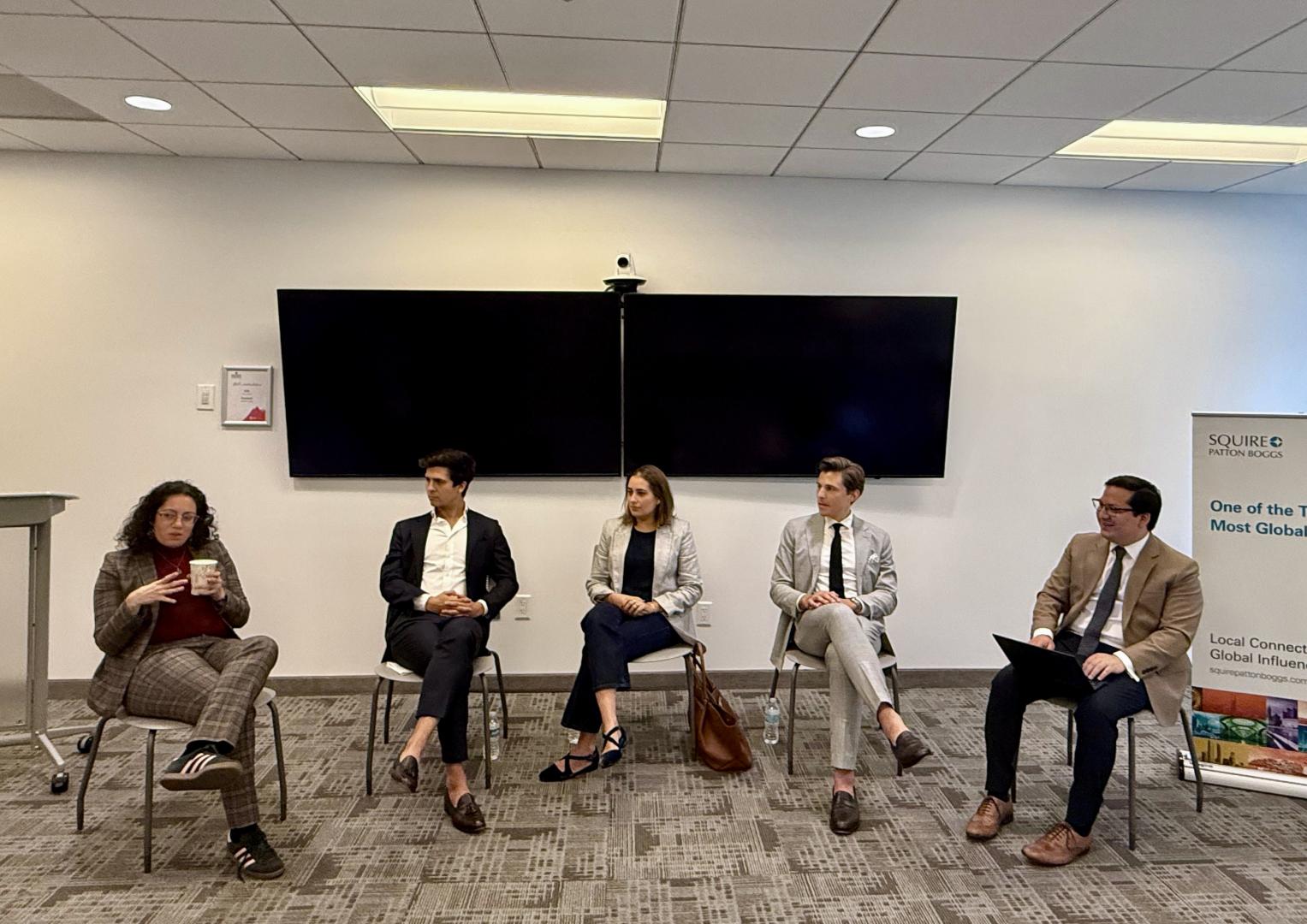
On 29 November 2025, as part of Miami Arbitration Week, Young ICCA hosted an in-person panel discussion on Artificial Intelligence (“AI”) in International Arbitration at Squire Patton Boggs’ Miami office.
The session brought together a panel of professionals who discussed the use, development, and deployment of AI as a legal-tech solution for everyday legal practice. The discussion was moderated by Jorge López Fung (Squire Patton Boggs), with opening remarks delivered by Gustavo Kulesza (Young ICCA Co-Chair & BMA Advogados). Panelists included: Nils Feuerhelm (Noxtua AG), Kiran Gore (Wolters Kluwer & Law Offices of Kiran N. Gore PLLC), Bianca Longo Campos (Jus Mundi), and Chris Bello (Harvey).
Opening Remarks and Panelist Introductions
Mr. Kulesza opened the session by highlighting the rapid expansion of Miami as a hub for international arbitration and the importance of critically engaging with emerging technologies. He emphasized that the panel’s unique value lay in the composition of professionals who engage with legal tools in varying manners, from initial development to use and refinement.
Efficiency Gains and Competitive Advantage
The panelists opened the discussion by first tackling the issue of efficiency gains and whether AI currently creates a competitive advantage for law firms or clients. Ms. Gore observed that efficiency depends heavily on the user’s knowledge of the tool. In her view, we are now in the learning phase of how to use AI, and as such, we should not expect optimal productivity at this initial stage. She emphasized that lawyers must first understand what tools exist and how to apply them to specific problems. From a provider’s perspective, she noted that staying current is essential, particularly given the speed at which digital legal resources are updated compared to traditional libraries. While generative AI has attracted significant attention, she suggested that other digital tools may currently offer more tangible efficiency gains.
Ms. Longo Campos offered a different view, stating that she uses AI tools daily and already experiences meaningful efficiency gains. She explained how platforms such as Jus Mundi allow users to work within encrypted environments and to upload confidential documents securely. She described using AI both as counsel and tribunal secretary, including for comparative legal research, drafting arguments, and stress-testing of submissions. She also noted that AI can assist with administrative tasks, such as drafting correspondence, and that agent-based tools can be configured to perform recurring tasks.
Confidentiality, Disclosure, and Ethical Considerations
One of the main concerns with the use of digital tools is the breach of confidentiality and consequent ethical violations. This was addressed by the panel as a hot topic.
Ms. Gore drew parallels between current debates on AI and earlier discussions regarding the role of tribunal secretaries for arbitral proceedings. She stressed the importance of transparency, particularly in the drafting of procedural orders, including disclosures on data privacy, confidentiality, and the use of external technology providers.
Mr. López Fung noted that while some firms have not yet adopted AI tools, others are actively using them, raising questions about client disclosure and internal training. He observed that no AI system can guarantee absolute confidentiality and suggested that tribunals should consider addressing the use of AI expressly in procedural orders.
Mr. Feuerhelm likewise cautioned that no digital tool can assure absolute confidentiality. Nonetheless, he noted that the legal sector has already achieved significant efficiency gains and is now moving toward the development of AI-enabled legal service products, including scalable business models that may be offered directly to clients.
Speed vs. Quality
The next topic of the discussion was how to ensure that increased speed does not compromise work quality. Mr. Feuerhelm cautioned that AI is not yet fully autonomous, and that the legal sector remains a relatively slow adopter compared to other industries. This, he explained, has both advantages and drawbacks.
Law Firms, In-House Teams, and Arbitrators
Ms. Longo Campos observed that AI tools adoption rates vary by firm size. Smaller and mid-sized firms may implement them more quickly due to fewer internal protocols, potentially giving them a temporary advantage.
Mr. Feuerhelm disagreed, noting that while large firms may move more slowly, once they commit resources, adoption tends to be swifter and more comprehensive.
Ms. Longo Campos agreed that once large firms fully commit, the impact can be significant. She also noted that in-house counsel often perceive efficiency gains most clearly because they are acutely focused on cost.
Mr. Bello highlighted differing incentives between law firms and in-house teams. In-house counsels are always seeking cost-reducing mechanisms and may use AI for preliminary document review before instructing external counsel. Law firms, by contrast, focus on speed and managing heavy workloads. He also noted that arbitrators tend to be more cautious, raising questions about whether AI use constitutes outsourcing decision-making and if its use requires prior permission from the parties.
Ms. Longo Campos noted that in the future, guidelines will be created to facilitate the effective use of AI by arbitrators.
The panel then turned to the overview of AI tools to support tasks such as cross-examination preparation. Mr Bello emphasized the importance of distinguishing between general-purpose tools and legal-specific platforms, noting that the appropriate use depends on the platform’s design and safeguards. He explained that legal-focused systems can allow users to upload documents for analysis, rely on structured workflows (including “clickable” prompt templates), and assist with digesting large documents. In his view, AI can often take users 70–80% of the way in tasks such as locating key documents, generating chronologies, and summarizing multiple documents. At the same time, he noted the present limitations, including drafting pleadings (such as a full statement of claim) or conducting legal research without controlled guidelines, given the risk of hallucinations.
Academia, Workflows, and the Changing Skillset of Lawyers
The panel also addressed whether legal education and academia are adapting quickly enough to the growing role of AI. Ms. Gore expressed the view that they are not. She observed that many lawyers are unaware of the technological tools already available to them and that, historically, adoption in the legal sector has been slow. In her view, meaningful efficiency gains require lawyers to first identify repetitive tasks they regularly perform, such as scheduling or document preparation, and then determine which AI tools can assist with those workflows. This process, she noted, is neither immediate nor intuitive and often involves a period of trial and error that may take up to a year before efficiencies materialize.
Ms. Gore further noted that the profession is evolving, with the emergence of new legal roles and that lawyers no longer perform the same functions they did a century ago. She emphasized that while ethical obligations prevent lawyers from outsourcing judgment entirely, junior lawyers today are expected to develop a broader skill set and can become productive more quickly than in the past.
Audience questions raised concerns about whether AI adoption may lead to fewer junior lawyer hires. This prompted a broader discussion on whether AI is truly “moving the needle” in legal workflows. Mr. Bello noted that different AI tools excel at different tasks, with current systems particularly effective for preliminary work such as outlines, hearing preparation, and early-stage analysis.
Ms Longo Campos added that Jus Mundi is already using agentic AI for functions such as arbitrator selection which previously took weeks or months and can now be completed much quicker using structured databases. By specifying desired criteria, users can generate profiles based on experience and expertise rather than personal networks, helping to reduce bias and focus selection on objective capabilities.
Training, Junior Lawyers, and Legal Education
The panel then turned to the impact of AI on junior lawyers and the need for training.
Ms. Longo Campos emphasized the growing importance of digital literacy, including knowing which tools to use for which tasks. She stressed that training should extend beyond junior lawyers to include senior associates and partners and highlighted Jus Mundi’s practice-oriented training sessions using cases at different procedural stages.
Mr. Feuerhelm suggested that universities should continue to focus on legal fundamentals, with law firms providing practical training on technology use. Several speakers noted parallels with earlier transitions from paper-based to digital legal research.
Questions from the audience raised concerns about reduced hiring of junior lawyers and over-reliance on AI. Ms. Longo Campos responded that critical thinking remains essential, while Mr. López Fung questioned how human oversight of AI outputs would develop. Mr. Feuerhelm compared AI supervision to reviewing work produced by junior colleagues, suggesting that oversight standards will evolve.
Agentic AI, Provider–User Collaboration, and Future Developments
The discussion concluded with forward-looking reflections on agentic AI and how increasingly autonomous systems may shape legal practice over the coming decade. Mr. Feuerhelm explained that an “agent” refers to an AI system capable of independently planning and executing tasks, such as identifying available calendar slots and generating corresponding communications. While current systems already demonstrate planning and reasoning abilities, he emphasized that the legal profession is still in an “agentic workflow” phase. In his view, the next five to ten years will bring significant change, even if the precise form of that transformation remains uncertain.
Building on this point, Mr. López Fung noted that agents could eventually handle tasks such as time recording and billing but stressed the need for a stronger bridge between technology providers and lawyers, who best understand legal workflows.
Ms. Gore and Mr. Bello emphasized the need for collaboration between lawyers and engineers to identify meaningful use, with lawyers being best placed to define workflows that require support.
In response to a final question on future developments, Ms. Longo Campos suggested that digital counterparts and continuous AI agents may soon feel routine. Mr. Bello predicted widespread use of agents that continuously monitor and curate legal information, while Mr. Feuerhelm noted that fully autonomous drafting of complex legal documents remains constrained by cost and computing power.
Ms. Gore highlighted the potential for agentic AI beyond core legal tasks, including identifying ideal client profiles and supporting marketing and administrative functions, underscoring that law firms are already experimenting with such uses.
Ms. Longo Campos explained that Jus Mundi has developed arbitration-specific agents, each trained around the tasks typically performed by arbitration practitioners.
Mr. Bello added that while many lawyers lack the time to consider how AI could assist them, innovation often depends on a subset of practitioners willing to take a first pass at defining workflows.
Finally, Mr. Feuerhelm cautioned that while document drafting remains a key ambition, fully autonomous generation of long-form legal documents is currently constrained by cost and computing power.
Conclusion
The panel offered a wide-ranging and practical discussion on the current and future role of AI in international arbitration. While speakers differed on the immediacy and scale of efficiency gains, there was broad agreement that AI is already reshaping workflows, research, and case preparation. The discussion also highlighted the importance of transparency, training, and ethical oversight as AI tools become increasingly integrated into arbitral practice. The next phase of development will depend less on technological capability and more on how effectively lawyers learn to integrate AI into their professional judgment.
Want to receive event updates from Young ICCA?
Sign up for Young ICCA Membership and you'll receive event notifications direct to your inbox.