Young ICCA Workshop: The Art of Oral Advocacy


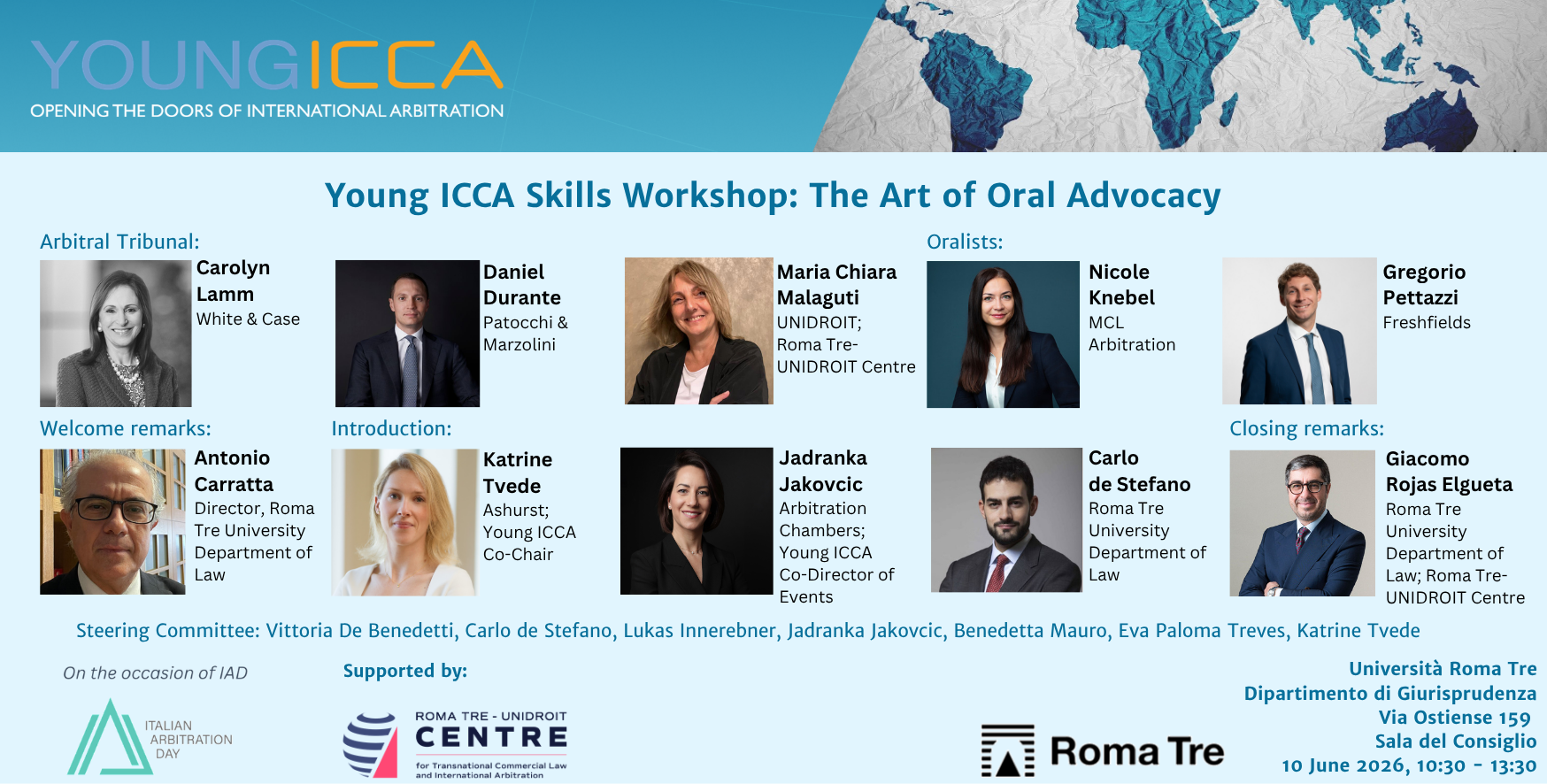
Young ICCA is pleased to invite you to the Young ICCA Skills Workshop: The Art of Oral Advocacy, taking place in Rome on 10 June 2026, on the occasion of Italian Arbitration Day.
The workshop will feature a mock oral advocacy exercise before a tribunal composed of leading arbitration practitioners and academics, followed by structured feedback and discussion on effective advocacy techniques in international arbitration. Designed to provide practical insight and hands-on experience, the session is aimed at young practitioners and students seeking to develop and refine their oral advocacy skills.
This workshop is organized by Young ICCA and the Department of Law of Roma Tre University with the support of the Roma Tre-UNIDROIT Center for Transnational Commercial Law and International Arbitration. The event is held in conjunction with the Italian Arbitration Day (IAD) as an official side event of the conference.
We extend our sincere thanks to the Organizing Committee and to our institutional partners for their invaluable support in making this event possible.
Post-Event Report
Post-Event Report by Elisabetta Orsini (Gianni & Origoni)
On 10 June 2026, Young ICCA hosted a skills workshop on Oral Advocacy at Roma Tre University, Department of Law. The workshop convened arbitration practitioners, academics and law students for a mock hearing focused on developing oral advocacy skills. The case concerned the disclosure of third-party funding arrangements and after-the-event (ATE) insurance in arbitration proceedings, inspired by the procedural issues of the 33rd Vis Moot.
Katrine Tvede (Senior Associate, Ashurst, UK), Co-Chair of Young ICCA, opened the workshop with introductory remarks and an overview of the organisation’s structure, its core mission, and the range of initiatives it supports across the international arbitration community. Carlo de Stefano (Associate Professor of International Law, Roma Tre University) introduced the workshop, reflecting on the importance of international arbitration within the Roma Tre academic community, the role of the Vis Moot as an educational vehicle for the future generation of practitioners, and the significance of providing support to young lawyers entering the field. Benedetta Mauro (Associate, Chiomenti, Rome) then briefly introduced the case study - a streamlined version of the 33rd Vis Moot problem - and outlined the issue to be pleaded: whether the tribunal should order Claimant, who had already disclosed the existence of a third-party funding arrangement with ATJ-Funding, to produce the underlying agreements with the funder and its ATE insurer.
The arbitral tribunal was composed of Carolyn Lamm (Partner, White & Case), Maria Chiara Malaguti (President Emeritus, UNIDROIT and Director, Roma Tre – UNIDROIT Centre for Transnational Commercial Law and International Arbitration), and Daniel Durante (Partner, Patocchi & Marzolini). Nicole Knebel (Associate, MCL Arbitration) and Veronika Timofeeva (Senior Associate, Freshfields) acted as oralists.
Submissions and Questions from the Tribunal
Ms. Knebel (Respondent’s counsel) argued in favour of disclosure on two main grounds:
- The tribunal has the power to order disclosure under both versions of the SIAC Rules. Under the 2025 Rules, Rule 38.4 expressly confers that power, and the broad SIAC definition of “third-party funder” - encompassing any entity with a direct economic interest in the outcome of the arbitration, including through indemnity against an adverse costs award - captures ATE insurance arrangements. Even under the 2016 Rules, the tribunal’s general power to order document production under Rule 27 applies, supported by SIAC Practice Note PN-01/17.
- Disclosure is warranted in the specific circumstances of the case: Claimant was expected to remain solvent only until September 2026, after which its continued solvency would depend on the contracts it negotiated for 2026 and 2027; Respondent faced significant legal costs in defending a claim of USD 3.3 million; and without visibility of the scope, coverage, and conditions of both agreements, Respondent could neither assess whether to bring a security-for-costs application nor verify whether an adverse costs award could ultimately be enforced.
The tribunal asked Ms. Knebel for clarifications on the practical utility of ordering full disclosure when the existence of the funding had already been declared and questioned whether a security-for-costs application would not be a sufficient alternative remedy. Counsel replied that the funder’s identity alone was insufficient for that purpose: uncertainty regarding Claimant’s continued solvency after September 2026 would not, in isolation, ground such an application, and the scope of AtJ-Funding’s actual commitment was entirely unknown. The tribunal also asked Respondent about the asymmetry of its position, noting that Respondent itself benefited from the support of its parent company without providing equivalent transparency. In response, Ms. Knebel drew a clear distinction between the two situations, submitting that third-party litigation funding gives rise to a discrete and quantifiable risk that adverse costs may prove irrecoverable - a risk that is not inherent in ordinary corporate support from a parent company.
Ms. Timofeeva (Claimant’s counsel) opposed disclosure because it is an exceptional remedy in international arbitration and Respondent had failed to demonstrate the specific circumstances required to justify it:
- Under the 2016 SIAC Rules, the chapeau of Rule 27 confined the tribunal’s powers to those expressly enumerated, and no agreement to extend those powers has been reached between the parties. The term “case” in Rule 27 refers to the legal dispute on the merits - here, the sale of the Vanilla Orchids - and not to procedural questions arising in the course of the arbitration.
- Under the 2025 Rules, even if Rule 38.4 grants the tribunal the power to order disclosure of the funding agreement, that provision does not extend to ATE insurance, which is not a funding arrangement in the relevant sense.
- In any event, the tribunal’s discretion should be exercised with restraint: Claimant has already disclosed the precise elements required by the SIAC Practice Note - the existence of the funding relationship, the identity of the funder and insurer, and whether ATE coverage is in place - and full disclosure of either agreement would expose commercially sensitive strategic information to Respondent before the substantive phase of the arbitration had even begun.
The tribunal asked whether the relevance-and-materiality test under Rule 27 extended to costs, given Respondent’s express prayer for a costs award. Claimant maintained that “case” in that provision is used strictly in the sense of the merits. The presiding arbitrator questioned whether characterising disclosure as exceptional was consistent with the broader trend towards transparency in international arbitration. Counsel acknowledged that balance was necessary but emphasised that the SIAC Practice Note was developed specifically in the context of conflicts of interest involving arbitrators - not as a basis for broad-ranging disclosure obligations - and that full production of the agreements went well beyond its requirements.
In rebuttal, Ms. Knebel underscored that the application sought not a strategic advantage but the minimum information necessary to assess whether adverse costs could be recovered, given the combination of uncertainty regarding Claimant’s continued solvency after September 2026 and the unknown scope of both agreements.
In sub-rebuttal, Ms. Timofeeva responded that confidentiality in third-party funding arrangements exists precisely to protect against the opposing party gaining an unfair insight into case strategy at an early stage of proceedings, and that no evidence of improper funder conduct had been alleged to justify departing from that general practice.
Tribunal Feedback and Observations
Following the submissions, the tribunal shared its feedback on the pleadings and broader observations on the roles of arbitrator and counsel.
The tribunal’s views reflected the genuine complexity of the issue: while the arguments in favour of disclosure were considered strong in light of the uncertainty regarding Claimant’s continued solvency after September 2026 and the unknown scope of the funding arrangements, the threshold for ordering production of commercially sensitive agreements remained high, and the existing disclosure was arguably consistent with the applicable standards.
The tribunal commended both counsel for their poise and clarity, noting that leading with a clear, short answer to tribunal questions - before elaborating - is a discipline more commonly preached than practised. The arbitrators also observed that neither advocate over-defended a weak point to the point of losing credibility, and that both maintained their line of argument without losing the thread when interrupted. One arbitrator added that counsel should treat hearing preparation as an exercise in anticipating vulnerability: internal sessions, in which colleagues raise the hardest possible questions, are among the most effective tools available. Another arbitrator offered a broader observation about the purpose of the applicable rules: much of the oral argument had focused on costs recovery and procedural fairness, but the original rationale for third-party funding disclosure requirements is primarily conflict-of-interest management for arbitrators - keeping that underlying purpose in view is a useful discipline when the rules can be read across multiple functions.
Q&A
Following the mock hearing, Eva Paloma Treves (Counsel, Foley Hoag LLP) moderated an open discussion on effective oral advocacy involving the tribunal and participants from the audience, including law students and practitioners from various jurisdictions.
A recurring theme was how to respond effectively to the tribunal’s questions. The panel agreed that a direct answer followed by elaboration is the baseline: a prolonged set-up before answering risks frustrating the tribunal and signals a lack of confidence. Where a question genuinely requires more precision than can be given on the spot, requesting leave to return to the point is preferable to an improvised answer that enters the record as a concession.
The panel also addressed the technique of strategic concession. Credibility was identified as a counsel’s most important asset: fighting a point that is plainly correct undermines the tribunal’s trust and makes the remaining arguments harder to advance. The better approach is to concede what cannot be defended, signal that concession clearly, and redirect attention to the points on which the case is genuinely strong.
On the question of how the responding oralist should structure the submission, the panel cautioned against remaining entirely on script: an advocate who fails to acknowledge the points raised to the first speaker risks appearing disengaged. The more effective approach is to be an active listener during the opposing submission and annotate the script with targeted responses, rather than restructuring it wholesale - while taking care not to allow the other side to monopolize the narrative.
The degree of flexibility available in real time depends heavily on experience; for those earlier in their career, staying closer to the script remains the safer course.
The discussion also touched on cultural and linguistic diversity. While expectations of courtesy and professional sobriety are broadly consistent across legal traditions, civil law practitioners may naturally draw on concepts such as good faith that carry different weight in common law contexts. Language proficiency was identified as a factor that can distort the perceived tone of an advocate: non-native English speakers may appear more abrupt than intended, though plainer and shorter sentences - which non-native speakers often use of necessity - can in fact communicate more effectively to a multilingual tribunal.
Concluding Remarks
The workshop underscored the importance of oral advocacy in international arbitration and offered valuable insights to both emerging and experienced practitioners.
Key takeaways:
- Answer tribunal questions directly: lead with a clear, short response and elaborate from there;
- Manage credibility and reputation carefully - concede what is plainly correct and advance the case on stronger ground;
- Be an active listener during the opposing counsel’s submission, but do not let the other side fix the narrative;
- Adapt to the tribunal’s composition, legal background, and reactions throughout the proceedings; and
- Keep the rationale of the applicable rules in view, alongside the specific arguments being made.
The workshop was jointly organized by Young ICCA and the Department of Law of Roma Tre University, with the support of the Roma Tre-UNIDROIT Center for Transnational Commercial Law and International Arbitration. Young ICCA extends its sincere thanks to Roma Tre University and the Roma Tre-UNIDROIT Center for their support in making the workshop possible.

Want to receive event updates from Young ICCA?
Sign up for Young ICCA Membership and you'll receive event notifications direct to your inbox.