Young ICCA Workshop on Oral Advocacy


Young ICCA is pleased to invite you to a Lunch Skills Training Workshop on Oral Advocacy.
Registration and lunch will begin at 12:00, and the event will start promptly at 12:30, running until 14:00.
The event will feature a mock pleading on the admissibility of evidence in arbitration, followed by structured feedback from a tribunal and an open discussion on effective oral advocacy techniques. Designed to provide practical insight and guidance, the workshop is aimed at young practitioners and students looking to sharpen their advocacy skills.
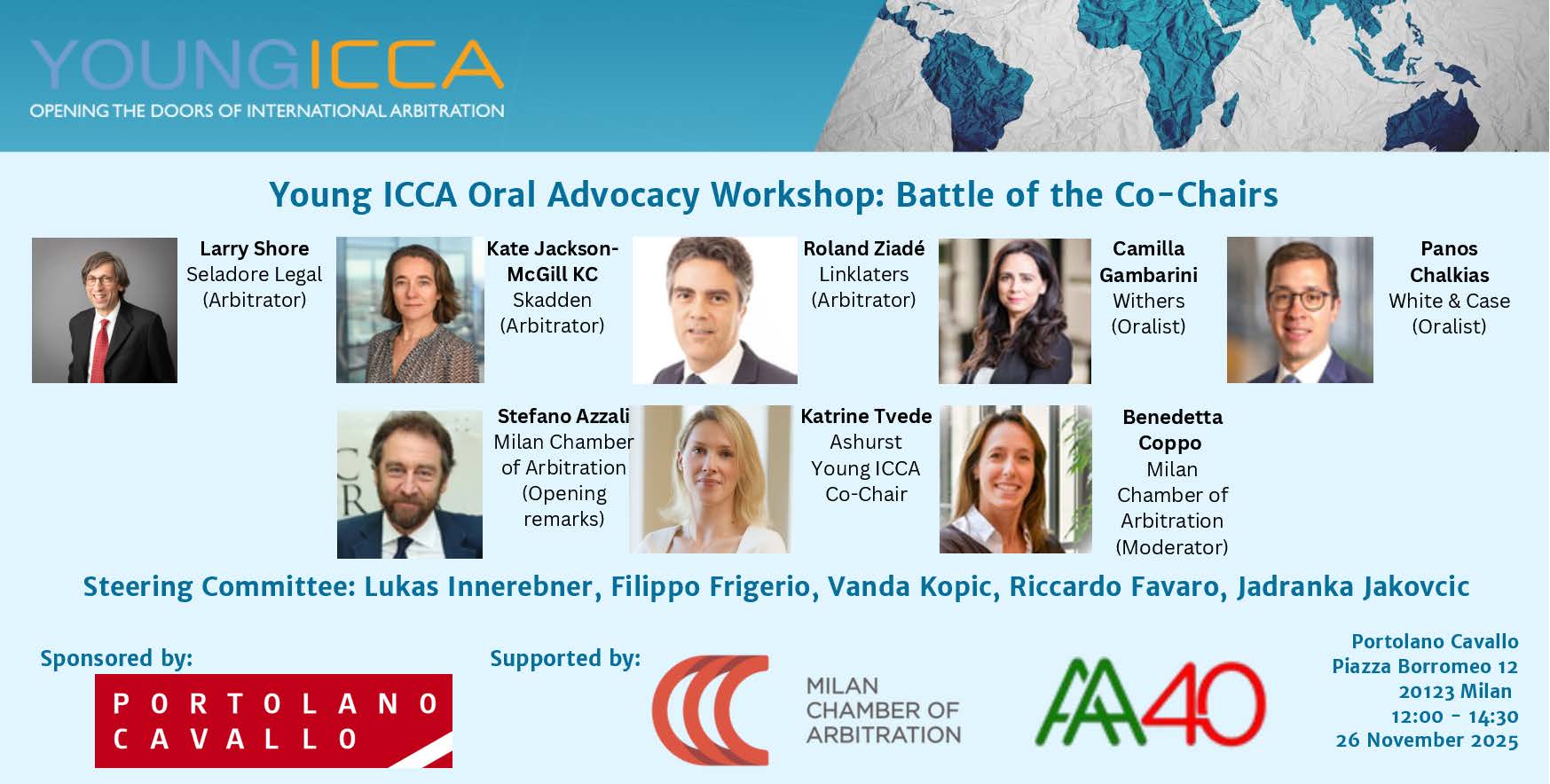
Our oralists are two rising stars in international arbitration (and former Young ICCA Co-Chairs):
- Camilla Gambarini, Special Counsel, Withers (London)
-
Panagiotis Chalkias, Associate, White & Case (Geneva)
The mock tribunal will consist of:
- Kate Jackson-McGill KC (formerly Davies), Skadden (London)
- Laurence Shore, Seladore Legal (Milan/London)
-
Roland Ziadé, Linklaters (Paris)
The session will be introduced by Stefano Azzali and moderated by Benedetta Coppo (both Milan Chamber of Arbitration).
The event will conclude with a networking coffee, offering participants an opportunity to connect and exchange ideas.
We extend our sincere thanks to Katrine Tvede (Ashurst / Young ICCA Co-Chair), Jadranka Jakovcic (Young ICCA Co-Director of Events), Vanda Kopic (Bonelli Erede), Filippo Frigerio (Portolano Cavallo), Riccardo Favaro (Legance) and Lukas Innerebner (Wartmann Merker) of the Organizing Committee for their invaluable support in making this event possible.
This workshop is organized by Young ICCA and sponsored by Portolano Cavallo, with the support of the Milan Chamber of Arbitration CAM, the Italian below40 Arbitration Association AA40 and the Italian Arbitration Association AIA.
The event will take place ahead of the main programme of the CAM Annual Conference. Participants of the Young ICCA Workshop can benefit from a Euro 50 reduced conference fee by choosing the option CAM Annual Conference – Reduced fee.
Young ICCA Skills Workshop: The Art of Oral Advocacy
Milan, Italy | 26 November 2025
Post-Event Report by Vittoria De Benedetti (BonelliErede)
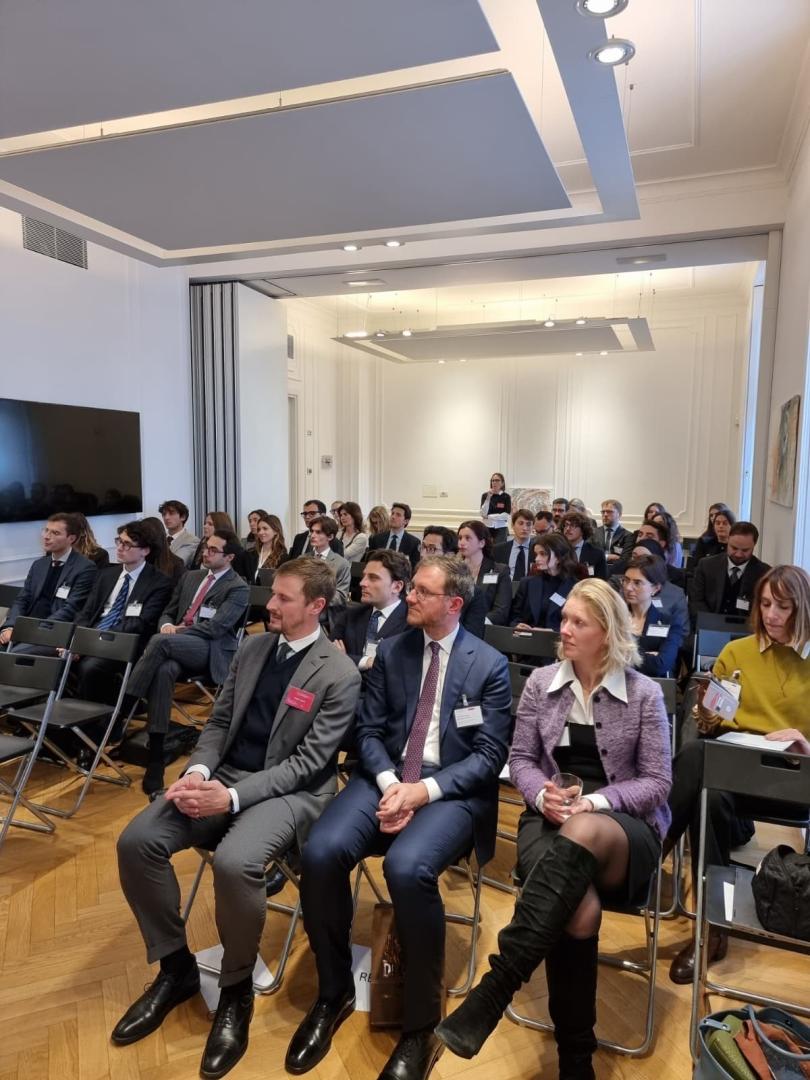
On 26 November 2025, Young ICCA, with the support of the Milan Chamber of Arbitration, the Italian below40 Arbitration Association AA40 and the Italian Arbitration Association AIA, hosted an Oral Advocacy workshop at the premises of Portolano Cavallo in Milan, ahead of the 2025 CAM Annual Conference. Practitioners argued a mock hearing on evidence admissibility inspired by the 32nd Vis Moot, sharpening real-world skills under time pressure and a hot bench.
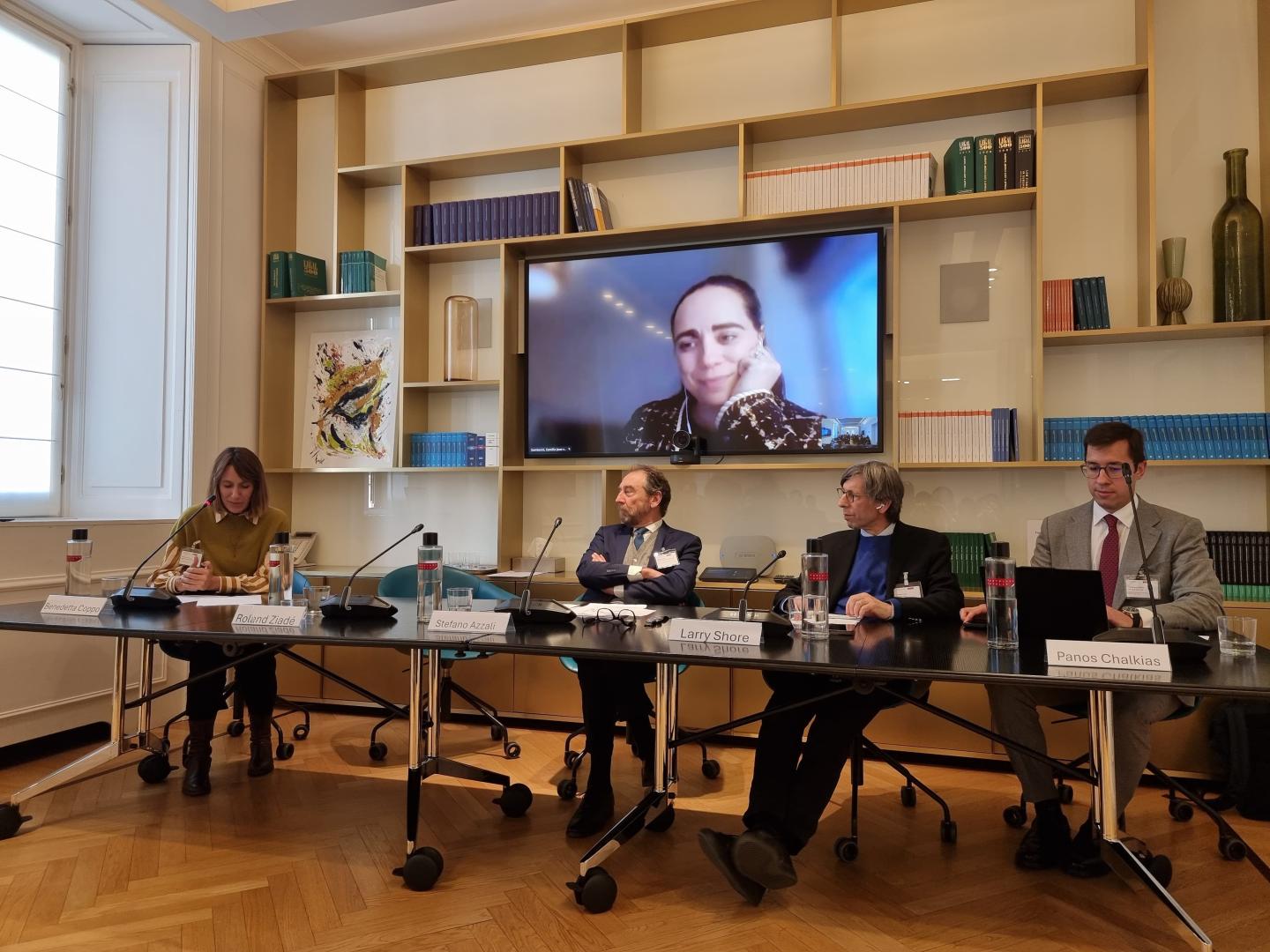
The event commenced with welcoming remarks by Filippo Frigerio (Associate, Portolano Cavallo, Milan), followed by the presentation by Young ICCA Co-Chair Katrine Tvede (Senior Associate, Ashurst, UK) of the Young ICCA’s founding history, mission, and activities, including the Mentoring Program. Next, Lukas Innerebner (Associate, Wartmann Merker, Switzerland), presented the members of the tribunal and the oralists and outlined the mock problem. The oralists, Panagiotis Chalkias (Associate, White & Case, Switzerland) and Camilla Gambarini (Special Counsel, Withers, UK) appeared before a distinguished mock arbitral tribunal composed of Stefano Azzali (Director of Milan Chamber of Arbitration, Italy), Larry Shore (Partner, Seladore Legal, UK/Italy), and Roland Ziadé (Partner, Linklaters, France). The oralists argued on the admissibility of two disputed evidentiary items, specifically an internal email sent by Claimant’s in-house counsel (Exhibit R-3), and an offer from Respondent labelled “without prejudice” (Exhibit C-7). The submissions focused on legal privilege, confidentiality, and procedural fairness.
Submissions and Questions from the Tribunal
Mr Chalkias, acting as Counsel for Claimant, addressed the admissibility of Exhibit C-7 first, followed by the inadmissibility of Exhibit R-3.
Mr Chalkias argued that Exhibit C-7 is relevant and material. In his view, it shows that mediation would have been futile (a take‑it‑or‑leave‑it 15% price reduction offer by Respondent) and that Respondent acted on instructions from the new Palatinum government.
He contended that Exhibit C-7 is neither confidential nor privileged and should be admitted into the record on the following grounds:
- Art 9 CAM Mediation Rules protects only commenced mediations, not pre‑mediation settlement talks. The Parties’ intention during the negotiations to extend Art 9 CAM Mediation Rules to all communications exchanged between the Parties was not reflected in the final and agreed wording of the contract.
-
Exhibit C-7 does not reflect a genuine attempt to settle the dispute, which could be protected under the settlement privilege rule; “without prejudice” labels do not create privilege by themselves. Under Article 9.4(b) IBA Rules on the Taking of Evidence (“IBA Rules”), the tribunal may take into account any need to protect the confidentiality of a document made in connection with and for the purpose of settlement negotiations, but only insofar as it is permitted by any mandatory legal or ethical rules that are determined by it to be applicable. In the present case, no mandatory legal or ethical rule would shield Exhibit C-7, regardless of which law is found to be applicable (the law of Palatinum, of Mediolanum or Italian law).
Mr Chalkias further argued for the exclusion of Exhibit R-3 from the record on the following grounds:
- Exhibit R-3 was likely obtained illegally (via a leak in the public prosecution office, inducement of a Claimant’s employee to unlawfully disclose it, or an unlawful state investigation).
- Under Article 9.3 IBA Rules, the tribunal can exclude illegally obtained evidence. In deciding whether to exclude illegally obtained evidence, arbitral tribunals weigh in international principles generally adopted in international arbitration, such as the principles of good faith, fairness, equality of arms and public policy enshrined, among others, in Articles 2 and 9.3 CAM Arbitration Rules.
-
Citing the Libananco v. Turkey case, Mr Chalkias concluded that admitting Exhibit R-3 would constitute a breach of these internationally recognised principles.
Ms Gambarini, acting as Counsel for Respondent, opposed the exclusion of Exhibit R-3, arguing that the document is relevant and material as it is the only document evidencing Claimant’s lack of good faith during the tender process.
In reply to Claimant’s claim to exclude Exhibit R-3 on the ground that it may have been illegally obtained, Ms Gambarini argued the following:
- The “illegal obtainment” theories are entirely speculative and unsupported.
- In addition, the allegations that Respondent may have illegally obtained Exhibit R-3 either during an illegal criminal investigation by the Government of Palatinum or through a leak in the public prosecution office, rest on Claimant’s erroneous and unsupported conflation of Respondent and the State of Palatinum. Even though it is a state-owned entity, Respondent is a separate entity, acting in its own commercial capacity, without exercising any state authority. The Libananco v. Turkey case, cited by Claimant’s Counsel, is inapposite, as in that case there was indeed conflation between the state and the company.
- The document is confidential under Article 9 CAM Mediation Rules which – as can be inferred from the drafting history of the contract – was intended by the parties to extend to all communications during negotiations.
- Exhibit C-7 was a genuine settlement offer, marked “without prejudice”. Thus, it is a privileged document, in application of the widely recognised international principle of confidentiality of settlement discussions.
- How did Respondent obtain R-3? Mr Azzali pressed Respondent’s Counsel on provenance. Respondent stood on the client’s assurance it had long possessed the document. If illegality were found, the tribunal should still weigh R‑3’s materiality.
- Good faith symmetry? Mr Ziadé asked whether the same good faith lens used to exclude R‑3 should apply to admit or exclude C‑7. Claimant argued in the negative, as the lack of consent in obtaining R‑3 is a critical distinction.
-
In‑house privilege in Mediolanum? Mr Shore queried the absence of privilege rules for in‑house counsel. Respondent urged the tribunal to follow international practice recognizing such privilege; Claimant countered that without such a rule, there cannot be any expectation of privacy.
Further, Ms Gambarini argued for the exclusion of Exhibit C-7 on the following two grounds:
In rebuttal, Mr Chalkias argued that C-7 is not a genuine offer to settle the dispute amicably. If it were, Claimant would have accepted it. Ms Gambarini, in her surrebuttal, maintained that C-7 is a genuine offer, and it was formulated by Respondent in the context of the parties’ settlement negotiations.
Following the submissions, the Tribunal posed several questions to counsel.
Discussion and Reflections
After the mock hearing, Benedetta Coppo (Milan Chamber of Arbitration) led a discussion about effective oral advocacy. This included topics such as body language, the strategic order of presenting arguments and the techniques for handling questions from the tribunal.
The discussion then moved on to practical tips and tricks for preparing for in-person and virtual hearings, also taking into account the composition of the tribunal.
Concluding Remarks
The workshop underscored oral advocacy’s importance in international arbitration and offered valuable insights to both emerging and experienced practitioners.
Key takeaways included:
- Master the file, own your facts;
- Pick your battle points, and dismantle the other side’s case;
- Speak simply, with short and easy phrases;
- Observe the tribunal’s reactions and questions.
The session was a sharp lead into the 2025 CAM Annual Conference. Closing remarks from Riccardo Favaro (AA40 Executive Committee) highlighted AA40’s work and upcoming initiatives.
Thank you to Portolano Cavallo (host), Young ICCA, the Milan Chamber of Arbitration, AA40, and AIA for co‑organizing and sponsoring.
Want to receive event updates from Young ICCA?
Sign up for Young ICCA Membership and you'll receive event notifications direct to your inbox.