Young ICCA Oral Advocacy Workshop


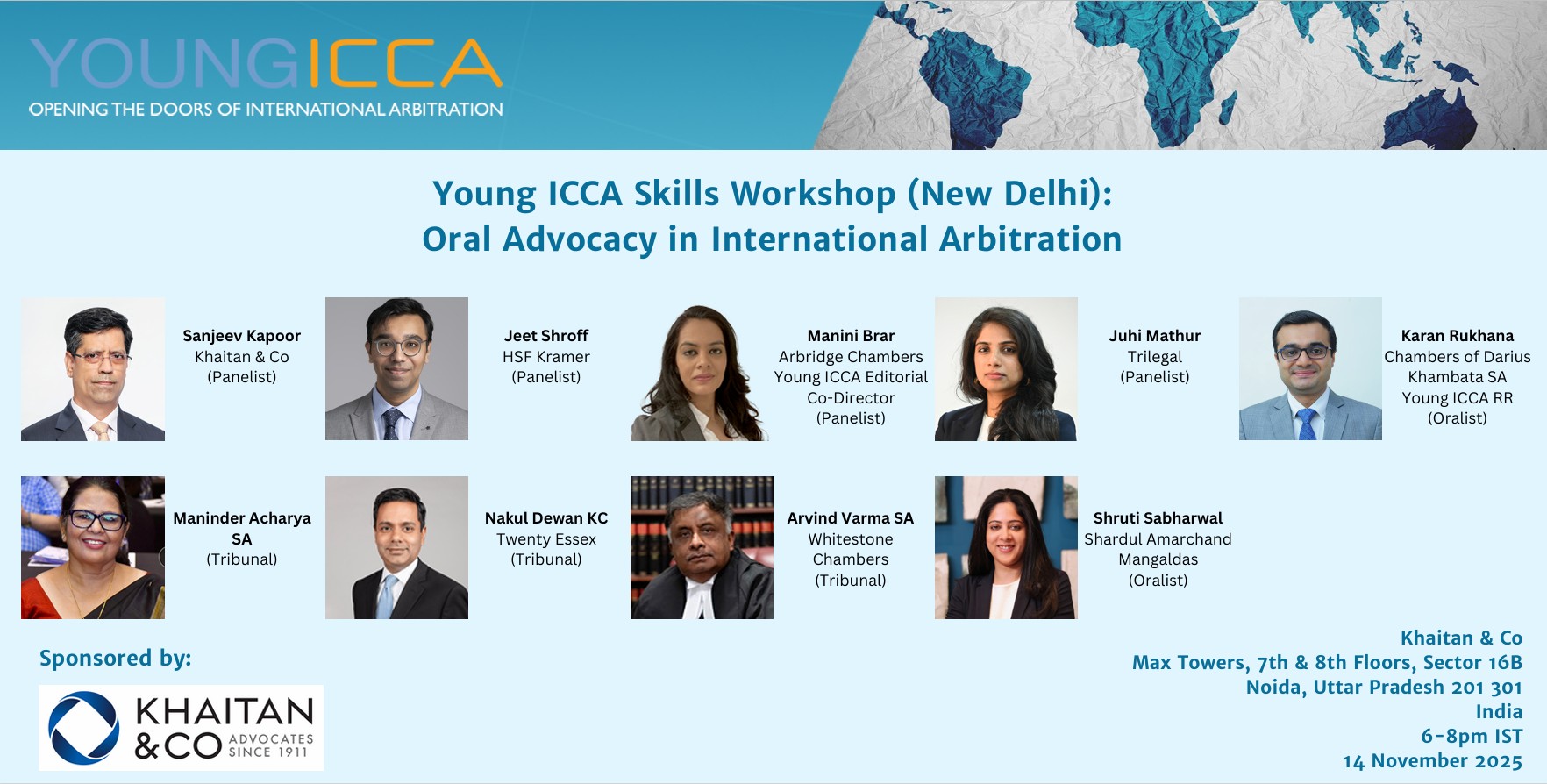
Young ICCA is pleased to invite you to a mock session on procedural and evidentiary aspects of an arbitration proceedings: Should the Tribunal exclude certain documents protected by confidentiality and privilege obligations? This workshop aims to provide practical insight and guidance to young practitioners.
This segment shall be preceded by a panel of leading experts discussing effective oral advocacy in international arbitration. The workshop segment is followed by a networking session.
Post-event report
Post-event report by Anant Narayan Misra (Shardul Amarchand Mangaldas & Co.)
On 14 November 2025, Young ICCA hosted an interactive workshop titled “Oral Advocacy in International Arbitration”. The event was held at Khaitan & Co, New Delhi and attended by a diverse audience of arbitration practitioners, arbitrators and students. The event provided a comprehensive exploration on oral advocacy, covering a full spectrum of topics ranging from pre-hearing preparation to the conduct of the hearing itself.
Panel Discussion: Strategic Insights
The session started with a panel discussion amongst Ayush Jain (Khaitan & Co, moderator), Sanjeev Kapoor (Khaitan & Co), Manini Brar (Arbridge Chambers), Juhi Mathur (Trilegal) and Jeet Shroff (HSF Kramer). The discussion examined the approach the practitioners adopt to prepare for an oral hearing in an arbitration. It underscored the importance of thorough and structured preparation while highlighting the need to adapt to the hearing. The panel also discussed the role of artificial intelligence in preparation process.
Preparation for the hearing
A recurring theme throughout the discussion was the question of how to best prepare for the hearing. The panel outlined a systematic approach to preparation, beginning with the assessment of the facts of the case, with particular attention to the weaknesses in one’s own client’s position. This enables one to adopt a holistic strategy and structure their arguments so that potential deficiencies are addressed proactively, rather than being exposed by the opposing side.
The panel emphasised the need for efficient time management, particularly in international arbitration where each party is afforded a limited timeframe. A common practice is to prepare a script and timing it. At the same time, it is essential to reserve adequate time for questions from the Tribunal. This practice helps one to ensure that they are adhering to the time allotted to them and at the same time ensuring that they make all the arguments they set out to make. The panel, however, cautioned against relying too rigidly on a script, underscoring the importance of remaining adaptable and responsive to the Tribunal.
The panel also highlighted the importance of effective document organisation to ensure that materials can be accessed seamlessly during the hearing.
Written Advocacy
The discussion addressed the importance of written advocacy and the need for consistency from the very outset of a case, beginning with the earliest correspondence. Arbitration ultimately becomes a test of how consistently a party can maintain its position, making it essential to determine the overarching strategy at the inception of the matter.
The panel observed that, in international arbitration, the majority of the case is decided on the basis of written submissions, with oral advocacy serving primarily to supplement the written record and to address any questions the Tribunal may raise.
The panel also reflected on the delicate balance between written and oral submissions. Often, parties may wish to avoid committing too firmly to certain positions at the early stages of the arbitration in order to retain flexibility in responding to the opposing side’s arguments. Accordingly, when drafting pleadings, counsel should consider which submissions ought to be included in the written phase and which may more appropriately be developed during the hearing. The panel emphasised that oral advocacy is inherently reactive, aimed at addressing the other party’s points rather than repeating what is already set out in the pleadings. Therefore, it is important to structure your arguments accordingly.
The Arbitral Tribunal
The panel also discussed the impact the Arbitral Tribunal has on the preparation. While much of the preparation remains consistent regardless of the Tribunal, certain considerations may prove beneficial. These include the jurisdictions in which the arbitrators primarily practise, as some legal systems adopt a more clinical approach and adhere more strictly to procedural rules, with courtroom practices often carrying over into arbitration. This stands in contrast to jurisdictions that take a more flexible view of procedure.
The panel further noted jurisdictional differences such as those seen in India, where counsel who regularly appear before courts frequently also serve as arbitrators. This overlap may result in arbitrators being more inclined to follow courtroom-style procedure and being comparatively less rigid about the time allotted to parties for oral arguments.
The panel additionally observed that international arbitration generally does not favour an aggressive style of advocacy, which may at times be more acceptable in court proceedings. Counsel must therefore remain mindful of their demeanour and adapt their advocacy style to suit the expectations of the arbitral forum before them.
Utilization of Artificial Intelligence
The panel also touched upon the advent of artificial intelligence and its impact on preparing for hearings. While encouraging the use of artificial intelligence to supplement the preparation process, the panel emphasised that such tools cannot replace it. Although artificial intelligence may be used to generate a script, the general experience has been that the output is not sufficiently on its own. Instead, one should prepare their scripts independently and then use artificial intelligence to refine and supplement their script.
Mock Application: A Practical Demonstration
Following the panel discussion, attendees observed a live demonstration of a mock hearing on whether certain documents protected by confidentiality and privilege should be excluded from the record. Shruti Sabharwal (Shardul Amarchand Mangaldas & Co.) and Karan Rukhana (Chambers of Darius Khambata SA) presented their submissions before a distinguished mock Arbitral Tribunal comprising Maninder Acharya SA, Arvind Varma SA (Whitestone Chambers) and Sanjeev Kapoor (Khaitan & Co).
The problem scenario involved a dispute between Claimant, GreenHydro Plc and the Respondent, Equatoriana RenPower Ltd.
The Claimant sought to rely upon the Respondent’s letter dated 25 May 2024 which contained an unsolicited without-prejudice offer demanding a 15% reduction in the price (“Exhibit C7”). The Claimant sought to rely on Exhibit C7 to demonstrate the futility of mediation and justify its decision to initiate arbitration without first engaging in the contractual pre-arbitral mediation process. The Respondent argued Exhibit C7 should be excluded as (i) the Claimant has violated the confidentiality of negotiation provided under Article 15.2 of the Mediation Rules of the Finland Chamber of Commerce (“Mediation Rules”) and (ii) Exhibit C7 was marked as “Without-prejudice Offer”.
The Respondent sought to rely upon an internal email by the Claimant’s in-house counsel which showed that the Respondent had made concessions relying on the Claimant’s promises, which the Claimant already were not going to be fulfilled (“Exhibit R3”). The Claimant argued Exhibit R3 should be excluded as (i) it is unclear how Respondent obtained Exhibit R3 but it was produced after the Claimant’s offices were raided and its executives’ laptops confiscated and (ii) Exhibit R3 was covered by legal privilege.
Shruti Sabharwal, on behalf of the Claimant, submitted that Article 15.2, applies only to documents obtained in the context of the mediation. However, Exhibit C7 was not issued in connection with the mediation as no mediation had admittedly taken place. Therefore, Article 15.2 and the FAI Mediation Rules were not applicable.
Secondly, the “Without Prejudice” privilege will not be able to Exhibit C7. “Without Prejudice” privilege is to encourage open settlement discussions between the parties, free from fear that statements or admissions made during settlement negotiations might later be used against them. This protection, however, is only applicable to genuine attempt to negotiate and will not be applicable where a party is simply asking for a concession rather than giving one. Merely marking a document as “Without Prejudice” does not automatically attract this protection. The Respondent by way of Exhibit C7 has given the Claimant an ultimatum to reduce the price, which could not be characterised as a genuine attempt at negotiation. Therefore, Exhibit C7 does not attract the protection of “Without Prejudice” privilege.
As for Exhibit R3, it is an internal document of the Claimant which was (i) not produced by the Claimant during disclosure and (ii) not shared by the Claimant with the Respondent. The Respondent had failed to explain how it obtained this document. Therefore, it can be reasonably concluded that the document was obtained illegally by the Respondent. Consequently, Article 9.3 of the IBA Rules on the Taking of Evidence in International Arbitration will be applicable wherein the Tribunal may exclude illegally obtained documents. Additionally, even if the document had been obtained legally, it was still protected by legal privilege as it was an email from the in house counsel of the Claimant.
Karan Rukhana, then appeared on behalf of the Respondent. He emphasised the importance of understanding the purpose for which each document was relied upon. If Exhibit C7 excluded, it would indicate that the Claimant had failed to comply with the contractual pre-arbitration step of mediation, rendering the commencement of arbitration premature. Conversely, if Exhibit R3 were admitted, it would demonstrate that the Claimant had knowingly made false representations during the negotiation of the agreement.
The Claimant sought to rely upon on Exhibit C7 and claimed that Article 15.2 of the FAI Mediation Rules were not applicable to it. However, Article 1.1 of the Mediation Rules provides when the parties agree to settle any dispute by mediation under the Mediation Rules, this will be deemed to mean that the Mediation Rules are part of the agreement to mediate. As the arbitration clause expressly provided that mediation would be conducted under the Mediation Rules, the Rules formed part of the parties’ contractual framework. Consequently, Article 15.2 applied to their correspondence. Exhibit C7 constituted an attempt by the Respondent to mediate the dispute, and therefore qualified as a document issued in connection with mediation and was protected under Article 15.2.
Secondly, Exhibit C7 was a “Without Prejudice” communication issued in the context of settlement discussions and was therefore inadmissible.
As for Exhibit R3, it demonstrated the Claimant’s knowledge of its own misrepresentations during the negotiation of the agreement. While the Claimant alleged that the document had been obtained illegally, it had provided no evidence to substantiate this claim. While the Claimant has alleged that Exhibit R3 was obtained illegally, it did not show any evidence to prove it. Therefore, these were only baseless allegations and unsubstantiated.
In the end, the Tribunal commended both advocates for their articulate submissions and for their adept handling of the issues. The simulation provided valuable insights into the advocacy skills required for such issues, as well as the considerations that tribunals must weigh when assessing requests for exclusion of documents. The demonstration underscored the importance of clear and persuasive argumentation and a thorough understanding of contractual interpretation.
Conclusion
The well-attended event provided practical exploration of oral advocacy in international arbitration, offering participants updated insights, strategic considerations, and practical guidance. The combination of a panel discussion and a live demonstration made the session particularly valuable for practitioners seeking to enhance their understanding of the approach one can adopt when preparing for a hearing.
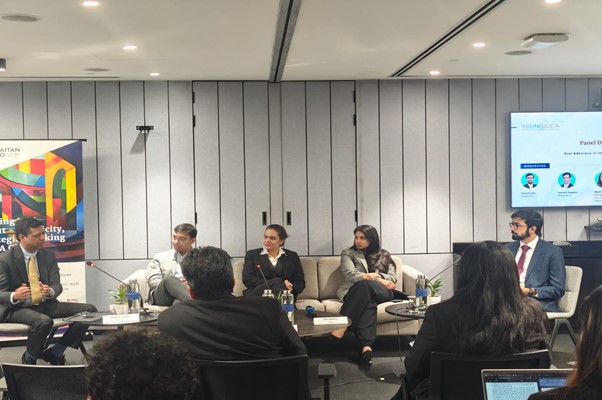
Left to right: Sanjeev Kapoor, Jeet Shroff, Manini Brar, Juhi Mathur and Ayush Jain
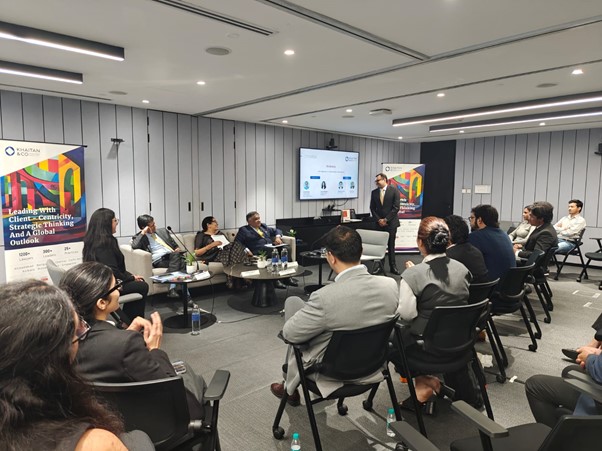
Left to right: Shruti Sabharwal, Sanjeev Kapoor, Maninder Acharya, Arvind Varma and Karan Rukhana
Want to receive event updates from Young ICCA?
Sign up for Young ICCA Membership and you'll receive event notifications direct to your inbox.